Financing Resistance: Supreme Liberty Life Insurance Company and Hansberry v. Lee
By Hannah Simmons
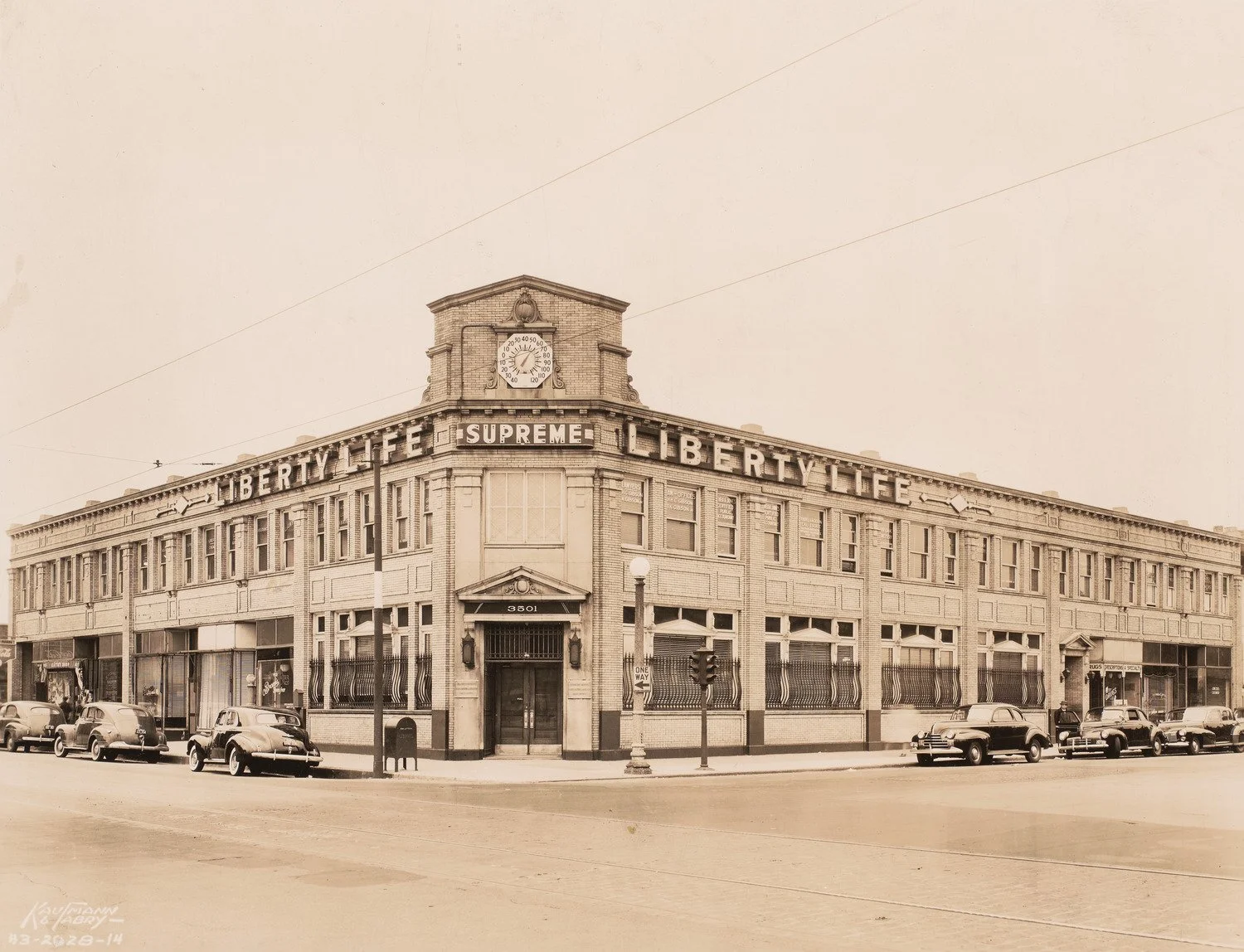
The headquarters of Supreme Liberty Life insurance, 3501 S. Dr. Martin Luther King Drive (then South Parkway) (Source: Chicago History Museum)
It was a quiet summer night. Young Lorraine Hansberry was sitting in the living room with her sister and her sister’s friend when a brick flew through the window, barely missing her head. When the police finally arrived, they blamed the Hansberrys for moving into the area. The Hansberrys, a middle-class African American family, had recently moved into the Washington Park subdivision in the Woodlawn neighborhood, and ever since, there had been trouble. This area, because of its wide-stretching restrictive covenants, was essentially a white-only neighborhood. So, the Hansberrys’ presence infuriated the neighbors. The neighbors did not stop at damaging the Hansberrys’ property. Rather, with the backing of the Woodlawn Property Owners Association, some of the neighbors filed a mandatory injunction to force the Hansberrys to sell the property and convey title to anyone other than an African American person within thirty days. This injunction ultimately became the Supreme Court case Hansberry v. Lee, which made a chink in the armor of housing discrimination. However, before the case appeared before the Supreme Court, Carl Hansberry and his family had to decide if they were willing to fight for the property that was rightfully theirs. Ultimately, Hansberry and his family decided that they would not leave without a fight. Carl Hansberry had known from the beginning that they would be in for a fight when they moved into the neighborhood. As a result, he had a plan to not only find a better life for himself and his family but also to erode racially restrictive covenants. That plan involved going to court and relied on the allyship of a rarely discussed legal partner, Supreme Liberty Life Insurance Company (SLLIC).
Known as the “kitchenette king” because “he could take a single six-room apartment on the South Side renting for $50/month, split it into six ‘kitchenettes’ (one-room apartments) that rented for $8 a week, and realize $192 a month for the same amount of floor space," Hansberry was also founder of the Lake Street Bank, one of Chicago’s first African American owned financial institutions, president and founder of the National Negro Progress Association, a business dedicated to improving African American business acumen, president and founder of the Hansberry Foundation, “dedicated to safeguard[ing] the Negro's civil rights and to mak[ing] additional housing available to them,” and a member of the board of the National Association for the Advancement of Colored People (NAACP).[1] It was through his work at the NAACP that he met and spoke with lawyer Earl B. Dickerson, who was also general counsel for SLLIC, in 1937, about his desire to purchase 6140 Rhodes Avenue just south of Washington Park in the Woodlawn neighborhood. Dickerson explained to Hansberry that the process of buying that property would be contentious. However, Hansberry stated that he knew and was willing to do so anyway. It is clear, then, that Hansberry knew what he was doing when he and his family purchased and moved into the racially restricted neighborhood of Washington Park. He knew that there would be trouble, but he was willing to go through the trouble to make a chink in the armor of racial discrimination in housing. To provide a chink in the armor of housing discrimination and move back to the home that was rightfully his, he relied on SLLIC.
The story of Hansberry v. Lee has been told many times, but one party has been underanalyzed: SLLIC. Though the role of the company is not as well known, it played a large part in the case, both financing the case itself and financing the $4400 mortgage that Hansberry used to purchase the apartment. This blog post seeks to illuminate the importance of SLLIC both in the Hansberry case and more broadly.
SLLIC was established on September 1, 1929, when Supreme Life and Casualty Company, founded by Truman K. Gibson Sr. in Columbus, Ohio, Northeastern Life Insurance Company, founded by Harry H. Pace in Newark, New Jersey, and Liberty Life Insurance Company, founded by Frank L. Gillespie in Chicago, IL, merged under the presidency of Harry Pace. Before sitting as president of SLLIC, Harry Pace lived many entrepreneurial lives. Pace was born on January 6, 1884, in Covington, Georgia. He graduated from Atlanta University and flourished under the mentorship of W.E.B. DuBois, with whom he published a short-lived magazine called The Moon Illustrated Weekly in Memphis, TN. While in Memphis, Pace worked as a cashier at Solvent Savings Bank and Trust Co. He then went to Atlanta, where he worked as secretary-treasurer of Standard Life Insurance Company. From Atlanta, Pace moved to New York and founded the Pace and Handy Music Company and the Black Swan Phonograph Company. He then moved to Newark, New Jersey, and became president and founder of Northeastern Life Insurance Company. According to a 1929 article in the New Pittsburgh Courier, Gibson and Pace initiated the merger of the three companies with Pace arguing, “that some of the many Negro insurance companies ought to get together and form one strong company.”[2] Gibson then traveled from Columbus to Chicago to discuss the idea with others.
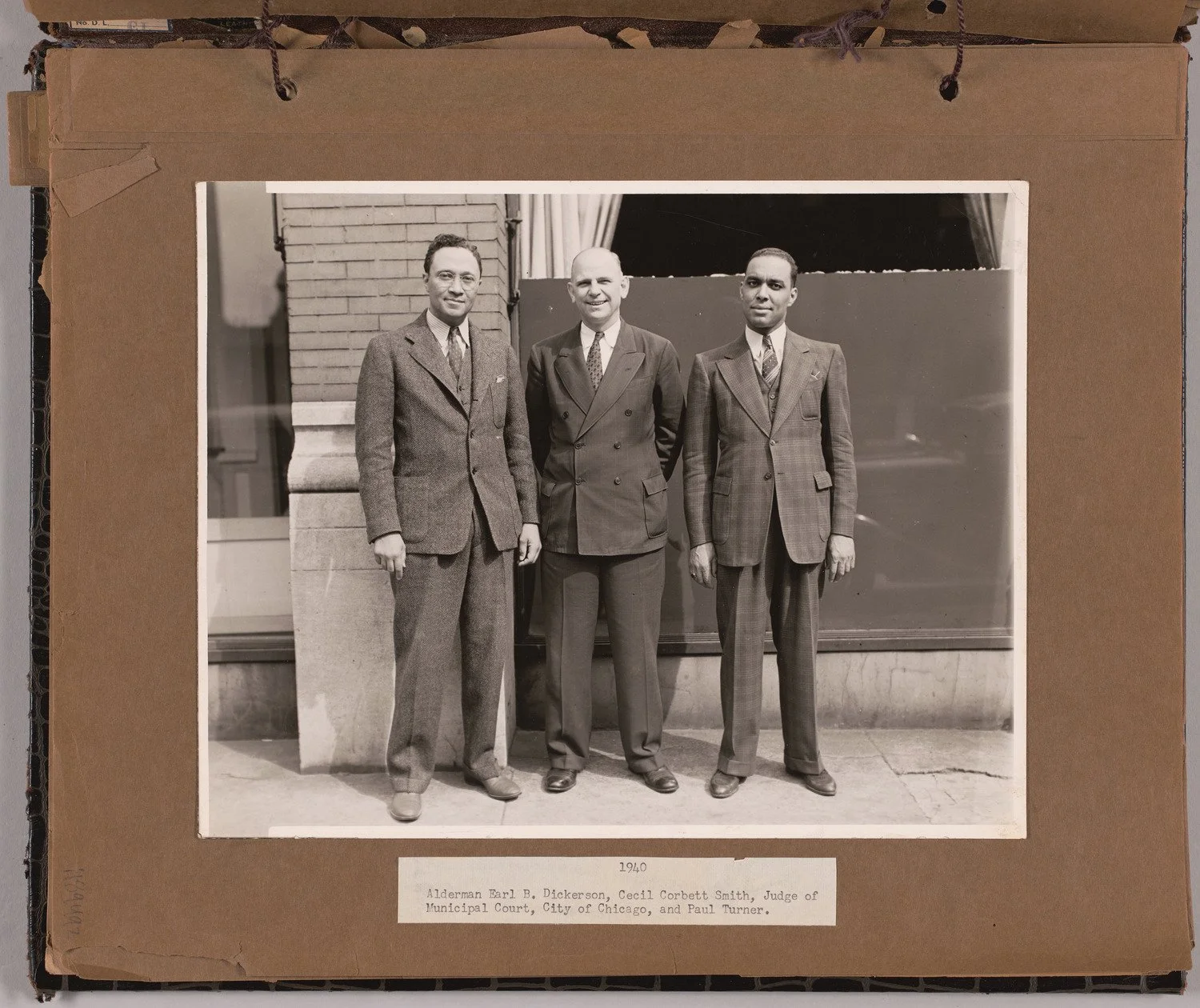
Earl B. Dickerson (left) as alderman with other Chicago officials, 1940 (Source: Chicago History Museum)
As a result of that meeting, and others, Earl B. Dickerson, who would become general counsel of SLLIC and eventually president, drew up the terms of the merger. According to The Call, a Kansas City newspaper,the 1929 merger was the largest “ever recorded in Negro business.”[3] After the merger, the company’s combined assets totaled $1,458,000, $27,635,665.26 in today’s dollars. Despite the significant combined assets and favorable conditions the company found itself immersed in (i.e., continued Black migration North, increased incomes, and growth of Black-owned businesses), the company, like so many others, was not prepared when the Great Depression struck. As journalist and author Robert J. Blakely states, “insurance companies throughout the country were in trouble during the depression, and African American companies were especially hard hit.”[4] Due in part to Earl B. Dickerson’s ingenious idea of turning policy liens into assets, the company survived the Depression. Indeed, not only did SLLIC survive, but it became increasingly profitable after 1938. By 1938, SLLIC’s assets were $2,261,564.83, today $52,358,779.70, and it held policies amounting to $39,707,806, $919,298,106.88 today, making it the largest Black insurance company in the North.[5]
SLLIC was coming of age during the 1930s, a time when white insurance companies, such as the Chicago National Life Insurance Company, transferred their African American policyholders to African American insurance companies. Furthermore, SLLIC had policyholders across the United States, including a large number in Lexington and central Kentucky, as well as Ohio, in part because white companies such as Anchor Life and Accident Company of Cleveland transferred the policies held by African American policyholders to SLLIC. White insurance companies, therefore, were both fueling a separate but equal doctrine and giving African American insurance companies business. Dealing with receiving clients from prejudiced insurance companies is only one of the complications that African American insurance companies had to deal with. Despite this challenge, SLLIC prided itself on serving its community.
In discussing its pride in serving the community, SLLIC made the point that the money that the community poured into it, the company poured back into the community. This is seen in SLLIC’s involvement with Hansberry v. Lee. However, before Carl Hansberry purchased his building, Harry Pace purchased a building nearby with a mortgage from SLLIC. Pace’s purchase also came under contention during Hansberry v. Lee. However, unlike Hansberry, in a 1940 Census record, Pace and his family are all listed as white, leaving one to wonder whether Pace’s purchase would have come under contention if his company had not come to Hansberry’s aid.
Carl Hansberry applied for a mortgage from SLLIC during the peak of the Great Depression. Instead of denying Hansberry the loan, with full awareness of his plans and the challenges involved, Dickerson, then general counsel for SLLIC, advised the company to grant Hansberry a mortgage. Though the board was hesitant, worried about the liability of providing a mortgage for a house in a neighborhood under racially restrictive covenants, Dickerson reminded the board that “the risk was consistent with its social goals.”[6] The board agreed and issued a mortgage. Additionally, when the case went to court, SLLIC paid up to $100,000, today around $2.3 million, in litigation costs.
SLLIC played a key role in the Hansberry case. Moreover, SLLIC was an influential force in the development of housing across Chicago and beyond. Ultimately, although “African American lending institutions had to contend with racial covenants, redlining, slum clearance, and in the wake of white flight and industrial flight in postwar decades---spiraling urban disinvestment,” SLLIC faced all these obstacles, especially racial covenants.[7] Despite the challenges SLLIC faced, including racially restrictive covenants, by 1969, under Dickerson’s leadership, it had become the third-largest African American insurance company in the country.
Notwithstanding its illustrious history, much research still needs to be done on SLLIC. African American insurance companies played a significant role in the African American community. They were leaders in the Black business sectors. Moreover, they provided life insurance, mortgages, and, in the case of Hansberry v. Lee, legal aid and financial support, when no one else would. They invested in a community that many companies viewed as a “risk” because they saw the value in the community. Furthermore, these African American life insurance companies, including, but not limited to SLLIC, were motivated to fight for, advocate for, and uplift the African American community. Thus, they provide a crucial image of racial uplift that deserves study. Though SLLIC provided undoubtedly significant services to the Hansberry v. Lee case, relatively little has been said about SLLIC’s engagement with it. This blog post has sought to rectify this issue and supply more information about SLLIC in general.
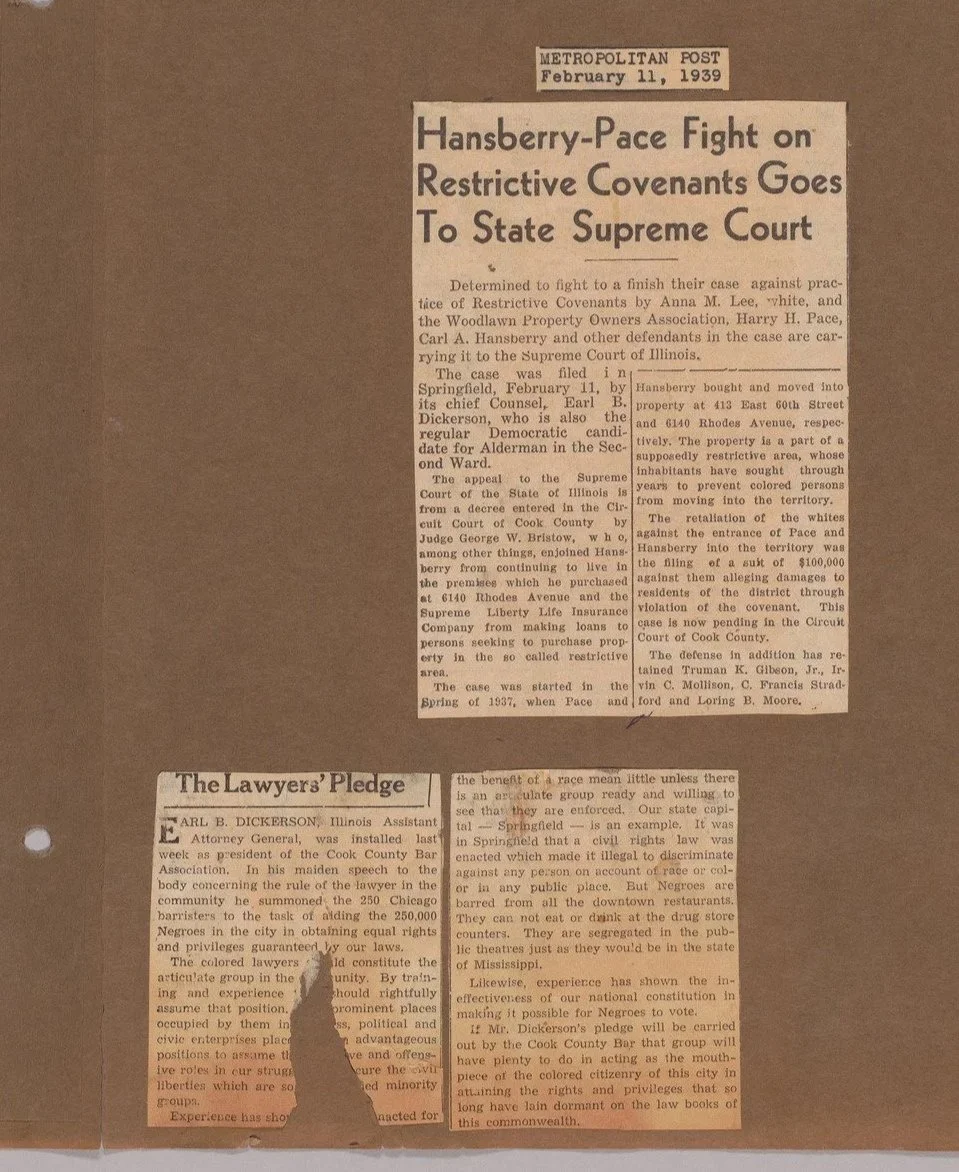
Newspaper coverage of Hansberry case at the Illinois Supreme Court (Source: Chicago History Museum)
[1] Charles J. Shields, Lorraine Hansberry: The Life Behind a Raisin in the Sun, (New York: Henry Holt and Company, 2022), 14, 24.
[2] “The Gigantic Insurance Merger That Startled the Entire Nation,” New Pittsburgh Courier, July 13, 1929. https://www.newspapers.com/image/40037476/?match=1&terms=harry%20herbert%20pace.
[3] “Supreme Liberty Life One of Leading Insurance Firms,” The Call, May 12, 1939. https://www.newspapers.com/image/1032071891/?match=1&terms=supreme%20liberty%20life%20insurance%20.
[4] Robert J. Blakely, Earl B. Dickerson: A Voice for Freedom and Equality, 172.
[5] “Supreme Liberty Life One of Leading Insurance Firms,” The Call, May 12, 1939. https://www.newspapers.com/image/1032071891/?match=1&terms=supreme%20liberty%20life%20insurance%20.
[6] Ibid, 96.
[7] Ginger Nolan, “Black Capitalism and the City,” Places Journal, April 2024. Accessed 18 Feb 2026. https://doi.org/10.22269/240416.