Covenants and the Making of the 1951 Cicero Race Riot
By Hannah Simmons
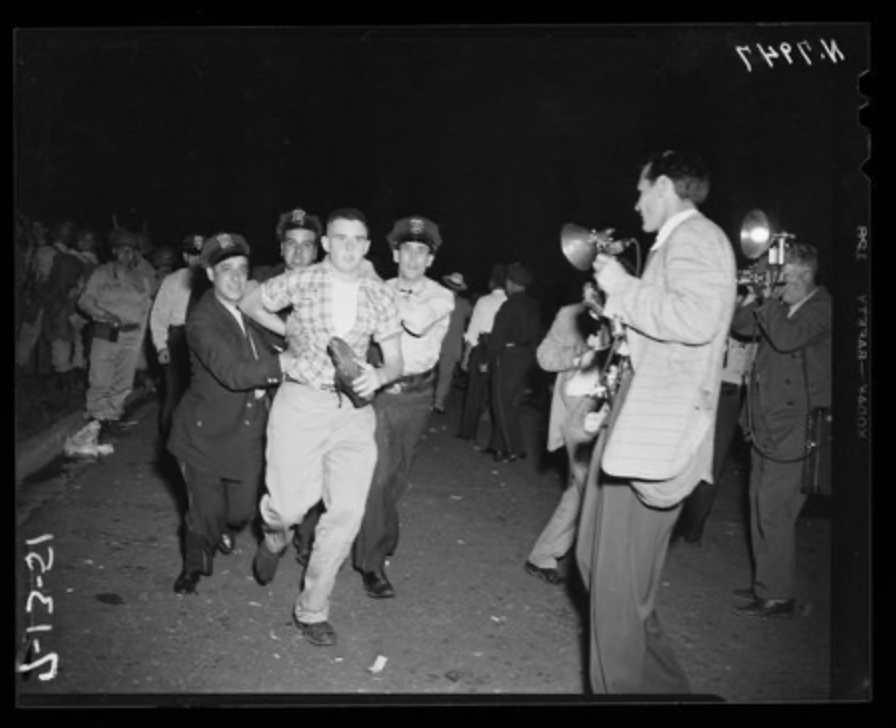
Policemen arresting a white rioter during the Cicero race riot, Cicero, Illinois, 1951 (Chicago History Museum)
Racially restrictive covenants justified anti-black violence in Cicero years before the outbreak of the Cicero Race Riot of 1951. In July 1944, seven years before the riot, the Federation of Chicago Neighborhoods lamented in Restrictive Covenants how unjust it would be for white soldiers to come home only to find that their “homes have been taken over by negroes.” The paper continued that if African Americans moved in, these once nice neighborhoods would become slums. The Federation’s overall argument conveyed a mindset that justified racial segregation and reinforced the commonly held fallacy that African American residents drove down property values. Furthermore, the Federation’s argument completely omitted African American soldiers’ involvement in the war, ignoring the fact that when African American soldiers came home, they were forced back into segregated housing, despite their sacrifice and fight for democracy abroad. In other words, though African American soldiers were pivotal to the victory against fascism abroad, the Federation still painted them as enemies to the progress of the domestic housing market. This mindset, fallacy, and disregard for African American servicemen’s sacrifice all fueled the 1951 Cicero Race Riots.
On July 11, 1951, a woman cheered along with a crowd as African American veteran Harvey Clark’s family’s furniture sailed through the shattered window, landing with a crash on the ground three stories below. “It’s a shame,” she stated, watching as someone started to set the Clark family’s furniture on fire, “Our boys are fighting and dying in Korea for democracy and look what’s happening here. Is this civilized? How does it look to the rest of the world?”[1]
To this woman, and the hundreds of Cicero, Berwyn, and Chicago residents who watched and participated in the destruction of the Clark family’s property, it wasn’t civilized for the Clarks to move into all-white Cicero. However, it was a mark of civility, and their right, to destroy the Clarks’ property and cause $50,000 (today approximately $623,000) in damages to the apartment building the Clarks had moved into. Additionally, this woman’s statement demonstrates that to her, integration was an affront to democracy, not an exercise in it. Though it’s unclear whether anyone at the Cicero Race Riot had read Restrictive Covenants, their actions and words mirror what was stated in the pro-covenant paper. This blog post analyzes the relationship between the Cicero Race Riots of 1951 and racially restrictive covenants. To do so, it is crucial to unveil what led up to the race riots.
A little more than a month before the riots began, on June 8, 1951, the Clark family attempted to move $2000 worth of their furniture into their new apartment. As a result, the rental agent was assaulted by the police and, with a gun pointed at his head, was told, “Get out of Cicero and don’t come back in town or you’ll get a bullet through you.” Not dissuaded, on June 26, the Chicago division of the National Association for the Advancement of Colored People (NAACP) requested an injunction on the Clark family’s behalf against Cicero officials to protect the Clarks’ right to move into their new apartment. The court agreed, and the judge declared that officials could not harass the Clarks and had to protect them as they moved into Cicero. Word spread that the Clarks were moving in. As word spread, so did rumors. Some said that the Clarks were Communists. Others stated that the Clarks’ moving into Cicero was part of a larger ploy to integrate the area. Neither was acceptable.
Under the watchful eyes of neighbors and the reluctant protection of the police, Harvey E. Clark Jr. (28), Johnetta Clark (26), and their two children, Michele Elaine Clark (8), and Harvey Evans Clark III (6), moved into their new apartment on July 10, 1951. After moving all their furniture, the Clarks left the scene, and the crowd dispersed. In the evening, the crowd returned and began to throw stones and chunks of concrete at the apartment windows. The next day, nine white families moved out of the building and put their furniture in storage.
County Sheriff John E. Babb did not want the Clarks to move in. He’d told the crowd that much the night before. However, even he knew that last night had gone too far. So, on July 12, he asked the governor to call in the National Guard for the first time in three decades to quell the riots and protect the building. In the evening, crowds faced off against the National Guard, Cook County Police, and Cicero Police. The crowds threw bricks, flares, and torches, starting a fire near the apartment that the fire department quickly quelled. By 12:51 am, the National Guard and police had pushed the crowd from the building. Around 70 people were arrested that evening, and over a dozen were injured. Over the next few days, 117 people were arrested. Most of them were let go. It wasn’t until September 18, 1951, that people were indicted, and it wasn’t anyone who had been involved in the riot.
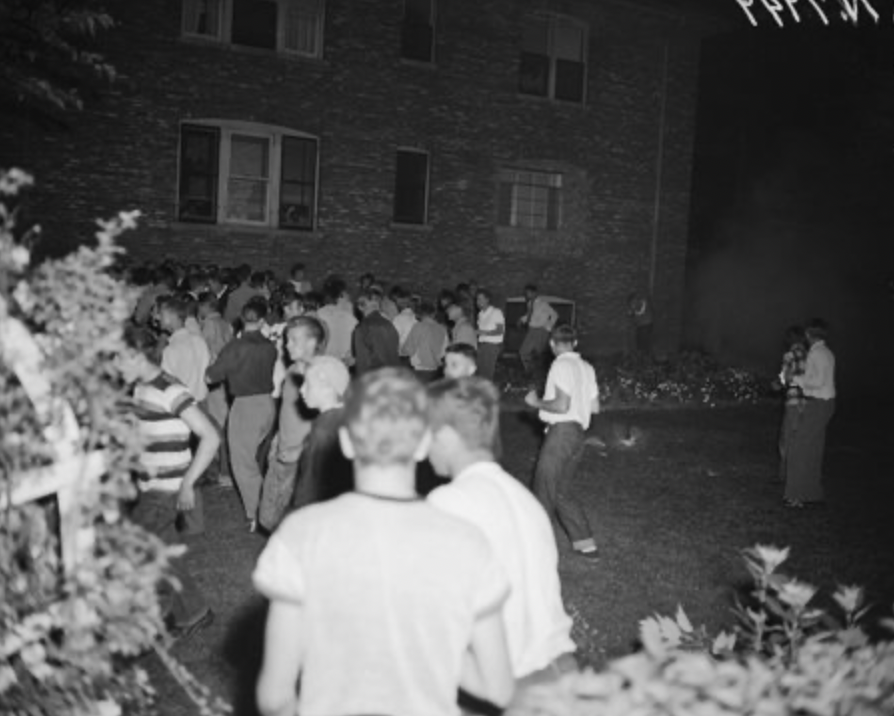
Tear gas during the Cicero race riot (Chicago History Museum)
On September 18, 1951, after two months of deliberation, the Cook County grand jury indicted the former owner of the building, Camille De Rose, Camille De Rose’s lawyer, George C. Adams, the family’s lawyer, George Leighton, and the real estate agent, Charles Edwards, for conspiracy to injure property by causing “depreciation in the market selling price” by selling to a black family. Groups like the Chicago Council Against Racial and Religious Discrimination lambasted this decision, stating that the jury ignored the rioting and destruction of property, the rights of the Clarks to live wherever they choose, and public officials’ duty to maintain law and order. Unless you look at the indictment through the lens of covenant logic and racial segregation, it doesn’t make sense. However, consider that texts focusing on segregation in housing from the 1920s to the 1950s argued that “the colored people certainly have a right to life, liberty, and the pursuit of happiness, but they must recognize the economic disturbance which their presence in a white neighborhood causes.”[2]
In One Hundred Years of Land Values (1933), influential scholar Homer Hoyt acknowledges that racial prejudice may contribute to reduced housing values. However, he argues that "if the entrance of a colored family into a white neighborhood causes a general exodus of the white people, such dislikes are reflected in property values.”[3] In this argument, Hoyt effectively translates racial dislike into reduced housing values and blames the reduced housing values on the presence of African Americans. Hoyt also quotes a “foreign observer” who said of white flight, “As soon as the Black people managed to gain a foothold in a few houses, then, along the entire street, for a length of 4 or 5 kilometers, sometimes 7 or 8, the houses emptied, the apartments became vacant, the white residents disappeared, giving way to the newcomers.”[4] Through his work, Hoyt helped codify a belief that was strongly held among real estate professionals that the fear of African American homeowners would cause reduced property values and ultimately turn the areas into a slum. This logic fueled the Cicero Race Riots of 1951 and the indictment of De Rose, Adams, Leighton, and Edwards.
After groups such as the Chicago Council Against Racial and Religious Discrimination protested the indictment of De Rose, Adams, Leighton, and Edwards, the federal government launched a probe. As a result of the probe, in 1952, four Cicero officials, including the mayor, police chief, fire marshal, and town attorney, and three policemen, were convicted of denying Harvey Clark Jr. of his civil rights when they prevented him from moving into his Cicero apartment. On July 10, 1952, a year after they moved into their Cicero apartment, the Clarks sued Cook County to recover some of the property loss. They were ultimately awarded $2400.
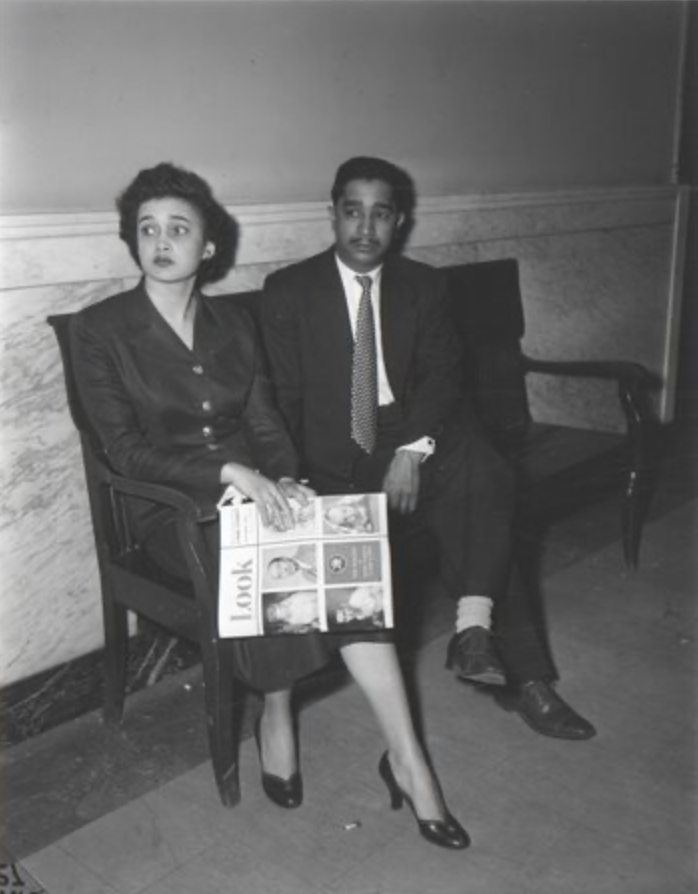
Harvey E. Clark and wife seated at bench during the Cicero Race Riot trial (Chicago History Museum)
Notes
[1] Camille De Rose, The Camille De Rose Story, (Chicago: Erle Press, Inc, 1953), 180.
[2] Charles Abrams, The Time Bomb that Exploded in Cicero, (New York: New York State Committee on Discrimination in Housing, 1951), 411.
[3] Homer Hoyt, One Hundred Years of Land Values: The Relationship of the Growth of Chicago to the Rise in Its Land Values, 1830-1933,(Chicago: University of Chicago Press, 1933), 314.
[4] Ibid 316.
Hannah Simmons is a 2025-2026 Black Metropolis Graduate Assistant, working with the Chicago History Museum and the Chicago Covenants Project.